

by retired Deputy Chief Howard Cohen
Ground ladders are one of the most basic and essential tools we use in the fire service. This is why it is important to master ladder skills early in your fire training and to continue practicing them throughout. Ladders are essential for many firefighting situations, including rescues, access to elevated areas, ventilation of structures, and establishing secondary means of egress. They are also often used in non-emergency situations. This is why every firefighter needs to develop a strong foundation in ladder knowledge, safety, and basic operations early in their training.
There are numerous ladder types. There are straight, extension, roof, and folding ladders (see Appendix 2 below for a detailed look at different types). There are ladders made out of aluminum, fiberglass, and wood. It is important that you are very familiar with the ladders your department uses. All ladders have some or all of the following components: beams, rungs, halyard, dogs, or pawls. For definitions of these terms, see Appendix 1. These parts might have different names in your fire district. In addition, it is important to know your ladder lengths. When you need to rescue someone from a second floor or higher, time is critical; you don’t want to pull a ladder that's too short.
It is not enough to know how to use a ladder; you need to know how to use it safely. Ladders are cumbersome, heavy objects to lift, carry, and raise into position. Therefore, to reduce the risk of injury when deploying a ladder, you need to know proper lifting techniques. Make sure you are familiar with basic shoulder carries, suitcase carries, and flat carries. Just as important, you need to be proficient at different types of ladder raises, such as the beam raise, flat raise, and basic extension ladder raise. Follow your department’s SOPs for the preferred ladder carrying and raising methods.
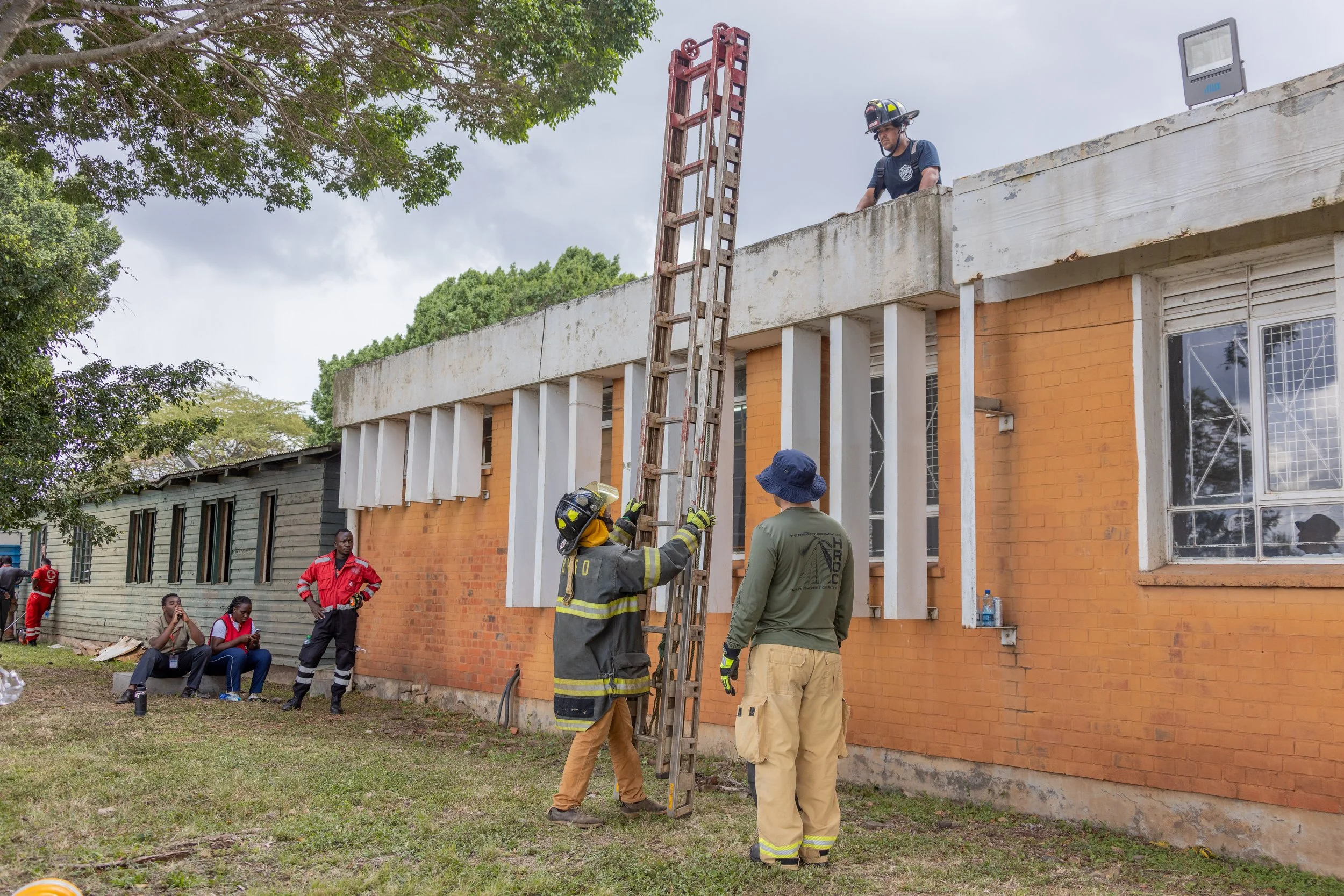
Effective ladder placement will keep you safe while allowing you access to difficult areas.
Another important ladder skill is placement: knowing how and where to place a ladder. Your department should establish SOPs for ladder placement based on the task at hand. For example, ladder placement for rescue purposes might differ from that for accessing the interior of a building. Other concerns with ladder placement include ground conditions, overhead obstructions, electrical hazards, and building stability. Make sure the ground is level and firm enough to support a loaded ladder. A general rule for the proper climbing angle for extension ladders is about 75 degrees. Alternatively, you can use the 4-to-1 rule. Leaning ladders should be placed 1 unit out for every 4 units up. However, ladder positioning may differ for other tasks, such as patient rescue, firefighter quick escape, ventilation, or roof access.
Finally, everyone needs to know how to clean ladders after use, inspect them, and report any damage. Review your department’s SOPs on ladder maintenance. Ladder skills and knowledge are vital to firefighter safety and operational effectiveness. A strong foundation in ladder types, safety, carries, raises, placement, and maintenance prepares you to perform essential tasks confidently and efficiently on the fireground.
Appendix 1: Ladder Parts
1: Beams (Rails)
The long side pieces that run the length of the ladder. They support the load and give the ladder its overall strength. On some ladders, the beams taper toward the tip to reduce weight.
2: Rungs (Steps)
The horizontal steps firefighters climb. They’re spaced evenly and designed with slip-resistant surfaces for boots and wet conditions.
3: Tip (Top)
The very top end of the ladder. It’s shaped to rest against a building or window sill and often includes ladder shoes or caps for grip.
4: Butt (Base)
The bottom end of the ladder that rests on the ground. Proper footing here is critical for ladder stability.
5: Butt Spurs / Ladder Shoes
Metal spikes or rubber pads at the butt that prevent the ladder from slipping. Spurs are used on soft ground; shoes are used on hard surfaces.
6: Halyard (Extension ladders only)
The rope used to raise and lower the fly section of an extension ladder.
7: Fly Section (Extension ladders only)
The movable upper section that extends to reach higher elevations.
8: Locks / Dogs / Pawls (Extension ladders only)
Mechanical hooks that engage the rungs to hold the fly section in place once raised.
9: Guides / Slides
Tracks that allow the fly section to move smoothly along the bed section.
Appendix 2: Types of Ladders
1: Straight Ladder
Single section, fixed length; Used for quick access to windows, roofs, and rescues. Often placed for secondary egress.
2: Extension Ladder
Two or more sections that extend using halyards and pawls. Provides greater reach than straight ladders. Common for upper floors, roofs, and ventilation.
3: Roof Ladder
Straight ladder with folding hooks at the top. Hooks secure over the roof peak. Designed for working on pitched roofs during ventilation.
4: Attic (Folding) Ladder
Short, collapsible ladder. Used in tight spaces like attics, closets, or scuttle holes. Easy to store and deploy indoors.
5: Aerial Ladders
These are permanently mounted on ladder trucks or quints. The ladder that extends hydraulically or mechanically. Provides high-angle access, rescue, and ventilation. Can support firefighters and victims.
6: Aerial Platform (Tower Ladder)
Features a bucket or platform at the tip. Allows safer rescue, master stream operations, and elevated work. Excellent for commercial or high-rise incidents.
Want to learn more about safe and effective ladder usage? Check out a Weekly Virtual Training by instructor and volunteer fire safety advocate Richard Gichina.